Showing posts with label TELANGANA MOVEMENT. Show all posts

Wednesday, April 25, 2018

Presidential Order 1975

 **The AP Public Employment (Organization of Local Cadres and Regulation of Direct Recruitment) Order 1975 is also called as Presidential Order 1975 
** It was issued based on the Constitution (32nd Amendment) Act 1973 which inserted 
Articles 371 D and 371 E in the Constitution of India 
**As per Section 97 of AP Reorganisation Act 2014, the Presidential Order 1975 will be implemented in both States (Andhra Pradesh and Telangana)

                                                             Presidential Order 1975 

In exercise of the powers conferred by clauses (1) and (2) of article 371-D of the Constitution, the President hereby makes, with respect to the State of Andhra Pradesh, the following order, namely:— 1. Short Title, extent and Commencement :– 
  (1) This order may be called the Andhra Pradesh Public Employment, (Organisation of Local Cadres and Regulation of Direct Recruitment) Order, 1975. 
   (2) It extends to the whole of the State of Andhra Pradesh. 
   (3) It shall come into force at once. 
2. Interpretation :– (1) In this Order, unless the context otherwise requires. 
(a) (City of Hyderabad) means the part of the State comprising the territories specified in the First Schedule; 
(b) (Direct Recruitment) Includes recruitment made on a temporary basis but does not include recruitment made in pursuance of any scheme approved by the State Government providing for the regularisation of the services of persons holding posts on a temporary basis before the commencement of this Order ; 
(c) (Local Area) in relation to any local cadre, means the local area specified in paragraph 6 for direct recruitment to posts in such local cadre, and includes, in respect to posts belonging to the category of Civil Assistant Surgeons, the local area specified in sub-paragraph (5) of paragraph 6 of this order; (d) (Local Authority) does not include any local authority which is not subject to the control of the State Government ; 
(e) (Local Cadre) means any local cadre of posts under the State Government organised in pursuance of paragraph 3, or constituted otherwise for any part of the State ; 
(f) (Local Candidate) in relation to any local area, means a candidate who qualifies under paragraph 7 as a local candidate in relation to such local area ; 
(g) (Major Development Project) means a development Project the cost or the estimated cost of which exceeds Rs. 5 crores and notified as such by the Central Government: 
(h) (Schedule) means a Schedule appended to this order ; 
(i) (Special Office or Establishment) means as Office or Establishment notified as such by Central Government; 
(j) (Specified Gazetted Category) means any gazetted category specified in the Third Schedule and includes any other gazetted category notified as such by Central Government ; 
(k) (State Government) means the Government of Andhra Pradesh; 
(l) (State-Level Office of Institution) means as office or institution serving, or the jurisdiction of which extends to the State as a whole and notified as such by the Central Government; 
(m) (Zone) means a zone specified in the Second Schedule comprising the territories mentioned therein; 
(2) The General Clauses Act, 1897 (10 of 1997) applies for the interpretation of this Order as it applies for the interpretation of a Central Act.
3. Organisation of local cadres :– 
(1) The State Government shall within a period of * twenty–seven months from the commencement of this Order, organise classes of posts in the civil services of and classes of civil posts under the State into different local cadres for different parts of the State to the extent and in the manner, hereinafter provided. 
(* Vide G.O. Ms. No. 728, G.A. (SPF.A) Dept, dt. 27-10-1977). 
Provided that, notwithstanding the expiration of the said period, the President may by order, require the State Government, whenever he considers it expedient so to do, to organise any classes of posts in the civil services of and clauses of civil posts under the State into different local cadres or different parts of the State. 
(Vide G.O. Ms. No. 34, G.A. (SPF.A) Dept, date 24-1-81) 
(2) The posts belonging to the category of lower division clerk and each of the other categories equivalent to or lower then that of a lower division clerk in each department in each district shall be organised into separate cadre. 
Explanation :— For the purposes of this sub-paragraph, sub-paragraph (1) of paragraph 6. and sub-paragraph (1) of paragraph 8 a category shall be deemed to be equivalent to or lower than that of a lower division clerk if the minimum of the scale of pay of a post belonging to that category or where the post carries a fixed pay, such fixed pay is equal to or lower than the minimum of the scale of pay of a lower division clerk. 
(3) The posts belonging to each non gazetted category, other than those referred to in sub-paragraph (2), in each department in each zone shall be organised into a separate cadre. 
(4) The posts belonging to each specified gazetted category in each department in each zone shall be organised into a separate cadre. 
(5) Notwithstanding anything contained in sub-paragraph (3) and (4), the State Government may where it considers it expendient so to do and with the approval of the Central Government, organised the posts belonging to any of the categories referred to therein, in any department, or any establishment thereof, in two or more contigeous zones into a single cadre. 
(6) Notwithstanding anything contained in sub Paragraphs (2), (3), (4) and (5), the Central Government ; may notify the departments in which and the categories of posts for which a separate cadre has to be organised for the City of Hyderabad and on such notification, the posts belonging to each such category in each such department in the said City (other than those concerned with the administration of areas falling outside, the said City) shall be organise into a separate cadre and the posts so organised in pursuance of this paragraph or Constituted otherwise and comprising posts belonging to the category in that department. 
(7) In organising a separate cadre in respect of any category of posts in any department for any part of the State, nothing in this Order shall be deemed to prevent the State Government from organising or continuing more than one cadre in respect of such category is such department for such part of the State. 
(8) Where the Central Government is satisfied that it is not practicable or expedient to organise local cadres under this paragraph in respect of any non gazetted category of posts in any department, it may, by notification, make a declaration to that effect and on such declaration the provisions of this paragraph shall not apply to such category of posts.
4. Allotment of Persons :— 
(1) Persons holding posts required to be organised into local cadres shall be allotted to such cadres by the State Government or any officer or authority authorised by it in this behalf in accordance with the principles and procedure hereinafter specified. 
(2) In allotting persons to local cadres due regard shall be had to all or any of the following, namely: (a) the administrative needs of the posts in the local cadres : (b) the need for the composition of balanced local cadres with reference to age and seniority groups; (c) the length of service of the persons concerned in the part of the State for which the local cadre is organised.  (d) knowledge of the persons concerned of the language spoken and the law in force in the part of the State for which the local cadre is organised; (e) preference of the persons concerned for allotment to any local cadre, where feasible. 
(3) The State Government may, in respect of different departments and different categories of posts, constitute committees to advice on the allotment of persons to local cadres. 
(4) Any person aggrieved by an order allotting him to any local cadre may submit a representation to the State Government within a period of sixty days from the Date of communication of the order. 
(5) The State Government shall on receipt of such representation and after consultation with the appropriate committee constituted under subparagraph (3) make such order as it deems fit. Provided that wherever such an order is likely to result in the change of allotment of any other person, no such order shall be made without giving an opportunity to that other person to make a representation. 
(6) Every order passed by the State Government under sub-paragraph (5) shall subject to the provisions of clause (3) of article 371-D of the Constitution of India, be final.
(5) Local Cadres and Transfer of Persons :— 
(1) Each part of the State, for which a local cadre has been organised in respect of any category of posts, shall be a separate unit for purposes of recruitment, appointment, discharge, seniority, promotion and transfer, and such other matters as may be specified by the State Government, in respect of that category of posts. 
(2) Nothing in this order shall prevent the State Government from making provision for 
       (a) the transfer of a person from any local cadre to any office or Establishment to which this order does not apply, or Vice Versa. 
       (b) the transfer of a person from local cadre comprising posts in any office or Establishment exercising territorial jurisdiction over a part of the State to any other local cadre comprising posts in such part of Vice Versa. 
       (c) the transfer of a person from one local cadre to another local cadre where no qualified or suitable person is available in the latter cadre for where such transfer is otherwise considered necessary in the Public interest. 
      (d) the transfer of a person from one local cadre to another local cadre on a reciprocal basis subject to the condition that the persons so transferred shall be assigned seniority in the latter cadre with reference to the date of his transfer to that cadre. 
(Vide G.O. Ms. No. 34, G.A. (SPF.A) Dept, dt. 24-1-1981)
6. Local Areas :— 
(1) Each district shall be regarded as a local area. 
   (i) for direct recruitment to posts in any local cadre under the State Government comprising all or any of the posts in any department in that district belonging to the category of a lower division clerk or to any other category equivalent to or lower than that of a lower division clerk. 
  (ii) for direct recruitment to posts in any cadre under any local authority within under that district carrying a scale of pay, the minimum of which does not exceed the minimum of the scale of pay of a lower division clerk or a fixed pay not exceeding that amount. 
(2) Each Zone shall be regarded as a local area. (1) for direct recruitment to posts in any local cadre under the State Government comprising all or any of the posts in any department in that zone belonging to any non-gazetted category other than those referred to in sub paragraph (1) 
(ii) for direct recruitment to posts in any local cadre comprising all or any of the post in any department in that zone belonging to the categories of Tahsildars, Asst. Executive Engineers, Assistant Agricultural Officers, Inspectors of Police and Motor Vehicle Inspectors 
(Vide G.O. Ms. No. 498, dt. 16-7-1977 G.O.Ms. No. 34, dt. 24-1-1981 and G. O. Ms. No. 635, G.A. (SPF. A) Dept. dated 30-11-1993) 
(iii) For direct recruitment to posts in any cadre under any local authority within that zone, carrying a scale of pay, the minimum of which exceeds the minimum of the scale of pay of a lower division clerk but does not exceed Rs. 480/- per mensum or a fixed pay which exceeds the minimum of the scale of pay of a lower division clerk but does not exceed Rs. 480/- per mensum or any amount corresponding to it as may be specified in this regard in the successive revisions or pay scales granted by the State Government from time of time. 
(G.O.Ms. 635, G.A. (SPF.A) Dept. dated 30-11-93. 
   Provided that where a single cadre has been organised for two or more zones under sub-paragraph (5) of paragraph 3 of posts belonging to any of the categories referred to in clause (i) or clause (ii) each of such zones shall be regarded as separate local area in respect of such cadre. 
(3) Notwithstanding anything contained in sub-paragraphs (1) and (2). 
(i) the City of Hyderabad shall be regarded as a local area for direct recruitment to posts in any local cadre under the State Government comprising all or any of the posts in the said City in the departments and belonging to the categories notified under Sub-paragraph (6) of paragraph 3 and the said City shall be excluded from the local area relatable to any other local cadre comprising posts in the departments and belonging to the categories so notified ; and 
(ii) the City of Hyderabad shall be regarded as a local area for direct recruitment to posts in any cadre under a local authority within the said City comprising posts carrying a scale of pay the minimum of which does not exceed Rs. 480/- per mensum or any amount corresponding to it as may be specified in this regarded in the successive revisions of pay scales granted by the State Government from time to time, or a fixed pay not exceeding that amount, and the said City shall be excluded from the local area relatable to any cadre under any local authority not within the said City. 
(G.O. Ms. No. 635, G. A. (SPF. A) Dept. dated 30-11-93) 
(4) Notwithstanding anything contained sub-paragraphs (1), (2) and (3). 
(1) the districts of Medak, Ranga Reddy and Hyderabad shall be regarded as a local area for direct recruitment to posts in any cadre under the Hyderabad Urban Development Authority comprising posts, carrying a scale of pay, the minimum of which does not exceed the minimum of the scale of pay of lower division clerk or a fixed pay not exceeding that amount. 
(ii) Zone VI shall be regarded as a local area for direct recruitment to posts in any cadre under the Hyderabad Urban Development Authority comprising posts, carrying a scale of pay, the minimum of which exceeds the scale of pay of a lower division clerk but does not exceed Rs. 480/- per mensum, or a fixed pay which exceeds the minimum of the scale of the pay of a lower division clerk but does not exceed Rs. 480/- per mensum or any amount corresponding to it as may be specified in this regard in the successive revisions of pay scales granted by the State Government from time to time. 
(Vide G.O.Ms. No. 498, G. A. (SPF. A) Dept. dt. 16-7-77 and G.O. Ms. No. 34, G. A. (SPF. A.) Dept, dt. 24-1-1981.)
7. Local Candidate :— 
(1) A candidate for direct recruitment to any post shall be regarded as a local candidate in relation to a local area. 
(a) in cases where a minimum educational qualification has been prescribed for recruitment to the posts. 
(i) If he has studied in an educational institution or educational institutions in such local area for a period of not less than four consecutive academic years ending with the academic year in which he appeared or, as the case may be, first appeared for the relevant qualifying examination; or 
(ii) where during the whole or any part of the four consecutive academic years ending with the academic year in which he appeared or as the case may be, first appeared for the relevant qualifying examination he has not studied in any educational institution, if he has resided in that local area for a period of not less than four years immediately preceding the date of commencement of the qualifying examination in which he appeared or as the case may be, first appeared. 
(b) In cases where no minimum educational qualification has been prescribed for recruitment to the post, if he has resided in that local area for a period of not less than four years immediately preceding the date on which the post is notified for recruitment. Explanations :— For the purpose of this paragraph. 
(i) educational institution means a University or any educational institution recognised by the State Government, a University or other competent authority; 
(ii) relevant qualifying examination in relation to a post means; 
(a) the examination, a pass in which is the minimum educational qualification prescribed for the post; (b) the Matriculation examination or an examination declared by the State Government to be equivalent to the Matriculation examination; which is lower ; and 
(iii) in reckoning the consecutive academic years during which a  candidate has studied, any period of interruption of his study be reason of his failure to pass any examination shall be disregarded. 
(iv) the question, whether any candidate for direct recruitment to any post has resided in any local area shall be determined with reference to the places where the candidate actually resided and not with reference to the residence of his parents or other guardian 
(Vide G.O.Ms. No. 168, G.A. (SPF.A) Dept. dt.10-3-77). 
(2) A candidate for direct recruitment to any post who is not regarded as a local candidate under sub-paragraph 
(1) in relation to any local area shall. 
(a) in cases where a minimum educational qualification has been prescribed for recruitment to the post. 
(i) If he has studies in educational institutions in that State for a period of not less than seven consecutive academic years ending with academic year in which he appeared or as the case may be, first appeared for the relevant qualifying examination be regarded as a local candidate in relation to (1) Such local area where he has studied for the maximum period out of the said period of seven years; or 
(2) where the period of his study in two or more local areas are equal, such local areas where he has studied last in such equal periods; 
(ii) If during the whole or any part of the seven consecutive academic years ending with the academic years in which he appeared or as the case may be first appeared for the relevant qualifying examination, he has not studied in the educational institutions in any local areas, but has resided in the State during the whole of the said period of seven years, be regarded as a local candidate in relation to 
(1) such local area where he has resided for a maximum period out of the said period of seven years : or 
(2) where the periods of his residence in two or more local areas are equal, such local area where he has resided last in such equal periods ; 
(b) in cases where no minimum educational qualification has been prescribed for recruitment to the post, if he has resided in the State for period of not less than seven years immediately preceding the date on which the post is notified for recruitment, be regarded as a local candidate in relation to 
(i) such local area where he has resided for the maximum period out of 20 the said period of seven years ; or 
(ii) where the periods of his residence is two or more local areas are equal such local area where he has resided last in such equal periods.
 (G.O.Ms. No. 168, dated 10-3-1977) 
8. Reservation in the matter of Direct Recruitment:– 
(1) 80% of the posts to be filled by direct recruitment any time. 
(a) in any local cadre under the State Government comprising posts belonging to the category of lower division clerk or a Category equivalent to or lower than that lower division clerk; and 
(b) in any cadre under a local authority comprising post carrying a scale of pay the minimum of which, or a fixed pay which does not exceed the minimum of the scale of pay or a lower division clerk, shall be reserved in favour of local candidates in relation to the local area in respect of such cadre. (
2) 70% of the posts to be filled by direct recruitment at any time. 
(a) in any local cadre under the State Government comprising posts belonging to non-gazetted categories other than those referred to in item (a) of sub-paragraph (1) and 
(b) in any cadre under a local authority comprising posts carrying a scale of pay, the minimum of which, or a fixed pay which exceeds the minimum of the scale of pay of a lower division clerk, but does not exceed Rs. 480/- per mensum on any amount corresponding to it as may be specified in this regard in the successive revisions of pay scales granted by the State Government from time to time shall be reserved in favour of local candidates in relation to the local area in respect of such cadre. (G.O.Ms. No. 635, G. A. (SPF. A) Dept, dated 30-11-93). 
(3) 60 % of the posts to be filled by direct recruitment at any time in any local cadre under the State Government comprising posts belonging to the categories of Tahsildars, Assistant Executive Engineers, Assistant Agricultural Officers, Inspector of Police and Motor Vehicle Inspectors shall be reserved in favour of local candidates in relation to the local area in respect of such cadre. 
(G.O.Ms. No. 498, G.A. (SPF. A) Dept, Dt. 16-7-1977) 
(G.O.Ms. No. 34, G.A. (SPF. A) Dept, Dt. 24-1-1981) 
(G.O.Ms. No. 635, G.A. (SPF. A) Dept, Dt. 30-11-1993). 
(4) Notwithstanding anything contained in sub-paragraph (2) or subparagraph (3) where, in respect of any of the categories referred to in the said paragraph a single cadre has been organised for two or more zones under sub-paragraph 
(5) of paragraph 3, 70% or as the case may be, 60 % of the posts to be filled by direct recruitment at anytime in such cadre shall be reserved in favour of and allocated amongst the local candidates in relation to each of the local areas in respect of such cadre in the ratio specified in the Second Schedule against the zone comprising each such local area. (5) 60% of the posts under the State Government belonging to the category of Civil Assistant Surgeons to be filled by direct recruitment at any time shall be reserved in favour of and allocated amongst the local candidates in relation to the local area specified in column 
(1) the Table below in the respective ratios specified in the corresponding entry is column 
(2) thereof. 
               
                                   
(6) while determining under this paragraph the number of posts to be reserved in favor of Local candidates any fraction of a post shall be counted as one. 
(7) while allocating under sub-paragraph (4) or sub-paragraph (5) the reserved posts amongst the candidates in relation to different local area fractions of a post shall be adjusted by counting successively the fractions in descending order of magnitude as one and where the fraction to be so counted cannot be selected by reason of the fractions being equal the selection shall be by lot. 
(8) Notwithstanding any thing contained in the foregoing provisions of this paragraph. (a) there shall be at least one post left unreserved out of the post filled by direct recruitment at any time to any local cadre; and (b) there shall be, as far as possible, at least one post allocated for the local candidates in respect of each local area. 
(9) Carry forward of reserved posts:—
If a qualified local candidate in respect of a local area is not available to fill a post reserved or allocated in favour of a local candidate in respect of that local area, such post shall be carried forward for recruitment of a local candidate in respect of that local area for period not exceeding three years:— Provided that pending recruitment of a local candidate.- Such post may be filled in temporarily by borrowing the service of a person holding a post of the same category in any other local cadre or under any other local authority as the case may be 
(Vide G.O. Ms. No. 34, dt. 24-1-1981). 
10. Power to Authorise issue of Directions : — 
(1) The President, may, by order, require the State Government to issue such directions as may be necessary or expedient for the purpose of giving effect to this Order to any local authority and such local authority shall comply with such directions. 
2) The State Government may, for the purpose of issuing any direction under sub-paragraph (1) or for satisfying itself that any directions issued under sub-paragraph (1) have been complied with require by order in writing any local authority to furnish them such information, report of particulars as may be specified in the order and such local authority shall comply with such order. 
11. Order to have over - riding effect : — 
The provision of this order shall have effect notwithstanding anything contained in any Statute, Ordinance, rule, regulation or other order made before or after the of this order in respect of direct recruitment to posts under the State  Government or any local authority. 
12. Removal of Doubts: — For the removal of doubts, it is declared that nothing in this Order shall affect the operation of provisions made by the State Government or other competent authority before or after the commencement of this Order in respect of reservation in the matter of appointments to posts in favour of any backward classes of citizens, the Schedule Castes and Schedule Tribes in so far such provisions are not inconsistent with this order, 
13. Certain appointment and promotions to be Provisional:— appointment or promotion made after the commencement of this Order or order made in pursuance of the provision to paragraph 3, as the case be and before any local cadre has been organised under the provisions this order or any order made in pursuance of the provision to paragraph 3, to any post which is required to be included in such cadre shall provisional and shall, within a period of twelve months after such organisation, be reviewed and readjusted in accordance with the provisions of this order, Explanation :— For the purposes of this paragraph, any local cadre shall be deemed to be organised with the allotment of persons to it under paragraph 4.
 (Vide G.O. Ms. No. 34, G.A (SPF. A) Dept., dt. 24-1-81) 
14. Saving:— Nothing in this Order shall apply to :— 
(a) any post in the Secretariat of the State Government., 
(b) any post in an office of the Head of a Dept., 
(c) any post in a special office or Establishment : 
(d) any post in a State-level office or institution. 
(e) any post other than a post belonging to any of the non-gazetted categories in the ministerial and technical services in a Major Development project; 
(G.O. Ms. No. 455, G.A. (SPF.A) Dept., dt.3-10- 1985 and 
(f) any post Police Officer as defined in clause (b) of Section 3 of the Hyderabad City Police Act, 1348 F.

                                                      THE FIRST SCHEDULE 

THE SECOND SCHEDULE
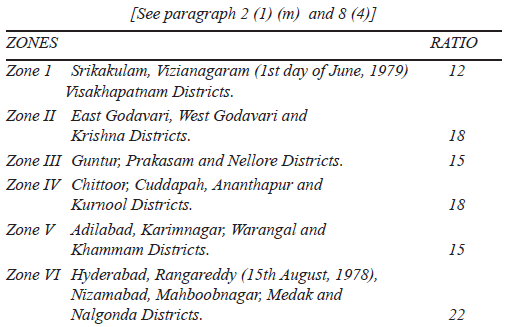
THE THIRD SCHEDULE


Friday, April 22, 2016

Emergence of Regional Disparities and Imbalances

AS PART OF TSPSC SYLLABUS IT MENTIONED -EMERGENCE OF REGIONAL DISPARITIES AND IMBALANCES IN DIFFERENT AREAS/SECTORS 
                                 1)POLITICAL POWER
                                 2)EDUCATION
                                 3)EMPOLYMENT
                                 4)AGRICULTURE
                                 5)IRRIGATION ETC
1)POLITICAL POWER
                                 The regional imbalances in the political system started since the formation of the state of andhrapradesh(1956).The political issues relating to representation of Telangana in the power sharing structure is clearly mentioned in the GENTLEMAN'S AGREEMENT-1956 i.e
 12).The Cabinet will consist of members proportionately 60:40 per cent for Andhra and Telangana respectively. Out of the 40 per cent Telangana Ministers, one will be a Muslim from Telangana.
  13).If the Chief Minister is from Andhra, the Deputy Chief Minister will be from Telangana and Vice versa. Two out of the following portfolios will be assigned to Ministers from Telangana: (a) Home (b) Finance (c) Revenue (d) Planning and Development and (e) Commerce and Industry.
As a consequence, Telangana leaders‟ voice has not been adequately represented in political decision-making and this has resulted in a lack of decisions in favour of the region. Lack of political voice has led to neglect and discrimination of the region by the more powerful Seema-Andhra side”.
The political space in the institution of Deputy Chief Minister (or Chief Minister) for the Telangana region was denied by the signatory to the Gentlemen‟s Agreement and the Chief Minister from Andhra area, Neelam Sanjeeva Reddy (who became the first Chief Minister of the united Andhra Pradesh) in the very first Ministry in 1956 by reportedly calling it an ”unwanted sixth finger of the hand”. Thus he was the first ‘Gentleman’ to violate the Gentlemen’s Agreement .This issue was to become a major sore point for Telanganites for all times to come.
Forced by the events caused by the discord that had been created, in the second ministry which was formed on January 11, 1960, with D. Sanjeevaiah as Chief Minister, this imbalance was rectified and Shri K.V. Ranga Reddy from Telangana was appointed as Deputy Chief Minister. This arrangement continued only for two years, whereafter, when Neelam Sanjeeva Reddy came back as Chief Minister, he again dispensed with the appointment of Deputy Chief Minister. The arrangement of Chief Minister/Dy. Chief Minister got restored only after the 1969 “Jai Telangana” agitation. 
Brahmananda Reddy’s six years of Chief Ministership (1964- 1971),He witnessed three violent agitations, one for a steel plant at Vizag, another for a separate Telangana State and the third, the Naxalite Movement in Srikakulam Vizag tribal areas.
P.V. Narasimha Rao became the Chief Minister of Andhra Pradesh in 30th September 1971-10th Januaray 1973, as the first Telanganite to assume the office .B.V. Subba Reddy was made the Deputy Chief Minister
president's rule-11th jan -10th dec 1973.
From 1973-1982, the popular Governments were headed by Telangana leadership.
**It started with a stable government with  J. Vengala Rao as Chief Minister(he was the ANDHRA SETTLER), after the lifting of the President‟s Rule.
       The J. R. Vimadalal Commission on J. Vengala Rao, former Chief Minister of Andhra Pradesh, was appointed to probe into attacks on Naxalites during his period in office and his earlier actions against Communist-inspired Naxalites during the 1960s have been referred to as a "reign of terror".
**In the General Elections held in February, 1978, for the A.P. Legislative Assembly, the Congress Party swept the polls and Dr. M. Channa Reddy became the sixth Chief Minister of A.P. on the 6th of March, 1978. He announced that, separate Telangana was no longer an issue. Owing to some factional squabbles in the party, Dr. Channa Reddy resigned in October, 1980
       Justice Muktadar of Andhra Pradesh High court was appointed as Oneman Commission to enquire into the rape incident happened at nallakunta police station and its consequences
T. Anjaiah as chief minister from-11th oct 1980-24 feb 1982  who remained in office only for one year and four months.
         In the year again chenna reddy took the office from-3rd dec1989-17th dec1990 he came to power with antiincumbancy on NTR

SOME FACTS
                                 CHEIF MINISTERS FROM TELANGANA
P.V NARSIMHA RAO-30/09/1971-10/01/1973
JALAGAM VENGALA RAO-10/12/1973-06/03/1978(ANDHRA SETTLER)
MARRE CHENNA REDDY-06/03/1978-11/10/1980
TANGUTURI ANJAIAH-11/10/1980-24/02/1982
MARRE CHENNA REDDY-03/12/1989-17/12/1990
          Interestingly none of the above completed five year tenure as chief minister P.v narsimha rao,chinna reddy,anjaiah as chief ministers for only 5.5 years only so many times Vengala rao considered as telangana but it is not true ,he is an andhra settler
                                     DEPUTY CHEIF MINISTERS
K.V RANGA REDDY
B.V.SUBBHA REDDY(RAYALASEEMA)
J.V. NARASING RAO
DAMODARA RAJA NARASIMHA
*FIRST CHIEF MINISTER FROM TELANGANA IN ANDHRAPRADESH- P.V NARSIMHA RAO
*CHIEF MINISTER DURING 1969 MOVEMENT-KASU BRAMHANANDA  REDDY
NOTE-WE HAVE COVERED ONLY ONE AREA OF FIVE -REMAINING SHORTLY 
                                 2)EDUCATION
                                 3)EMPOLYMENT
                                 4)AGRICULTURE
                                 5)IRRIGATION ETC

Monday, April 18, 2016

GO-610

SIX POINT FORMULA – Andhra Pradesh Public Employment (Organisation of Local Cadres & Regulation of Direct Recruitment) Order, 1975 – Alleged violation in the implementation of Six Point Formula in Zones V to VI – Rectification – Order – Issued. 
                            GENERAL ADMINISTRATION (SPF-A) DEPARTMENT 
G.O.Ms.No.610                                             Dated the 30-12- 1985 
                                                           Read the following 
1.G.O.Ms.No.674, G. A. (SPF-A) Dept., dated 20-10-1975. 
2.G.O.P.No.728, G. A. (SPF-A) Dept., dated 01-11-1975. 
3.G.O.P.No.729, G. A. (SPF-A) Dept., dated 01-11-1975. 
4. From the President, Telangana Non-Gazetted Officers Union, letter dated 05-12-1985 
                                              * * * O R D E R: 
The G.O. 1st read above, which is generally known as Presidential Order contains principles regarding Organisation of Local Cadres allotment of personnel of the various Departments to the various local cadres, method of direct recruitment to the various categories, inter-local cadre in transfers etc. of the employees holding those posts. In the G.Os 2nd and 3rd read above clarificatory instructions were issued regarding procedure for implementation of the various provisions of the Presidential Order. 
2. In accordance with the provisions of the Presidential Order, local cadres have been organized to the various categories of posts in all Government Departments and allotment of personnel was made as per the guidelines contained in paragraph 4 of the said order. 
3. In the representation 4th cited, the President, Telangana Non-Gazetted Officers Union has represented that certain allotments have been made in violation of the provisions of the Presidential Order. 4. The Government after carefully examining the issues raised in the representation and after having wide ranging discussion with the representatives of the Union have entered into an agreement with the Telangana Non-Gazetted Officers Union on 07-12-1985.5. As per the terms of agreement the following orders are issued: 
(1) The employees allotted after 18-10-1975 to Zones V & VI in violation of zonalisation of local cadres under the Six Point Formula will be repatriated to their respective zones by 31-03-1986 by creating supernumerary posts wherever necessary. 
(2) In respect of Jurala, Srisailam Left Canal and Sriramsagar Project Stage-II, all the staff in the Non-Gazetted categories both technical and non-technical including Asst. Executive Engineers (formerly JEs) coming under zonalisation of local cadres under the Presidential Order of 1975 who were posted to the projects from outside zones V and VI after 01-03-1983, will be retransferred to their respective zones and posted either in existing vacancies in various Government Establishments in those zones or in supernumerary posts where vacancies are not available. Towards this the Government will also move the Government of India for seeking amendment to Government of India’s notification G.S.R. 525(E) dated 28-06-1985 to give retrospective effect to this order with effect from 01-03-1983. 
(3) (a) In respect of appeals filed against orders of allotment made under paragraph 4 of the Presidential Order of 1975 to the competent authority in time and where such appeals are still pending disposal, all such cases where details are furnished by the T.N.G.Os Union or individuals, shall be disposed of by 31-03-1986. 
    (b) As a result of the above exercise, consequential vacancies if any, arising shall be filled up as per the procedure laid down under the Presidential Order. 
(4) In respect of first level Gazetted posts in certain Departments which are outside the purview of the Presidential Order, action should be taken to review the question of inclusion of such posts also in the scheme of localization and the matter should be taken up with the Government of India for suitable amendment to the said order. 
(5) The posts in Institutions/Establishment notified in G.S.R. No.526 (E) dated:18-10-1975 shall be filled up by drawing persons on tenure basis from different local cadres on an equitable basis as per the orders issued in the G.O. 3rd read above. 
(6) The provision in Para 5(2) (c) of the Presidential Order relating to inter-local cadre transfers shall be strictly implemented and such transfers shall be effected only under exceptional circumstances in public interest. 
(7) Action will be initiated in the concerned departments in cases brought to their notice regarding bogus registrations in Employment Exchanges. 
(8) On receipt of complaints, if any, made by the TNGOs Union relating to irregular allotments of candidates particularly to Zones V and VI in the category of Village Assistants the concerned department shall take up the matter with the A.P. Public Service Commission and take such measures as may be necessary to rectify the irregular allotments made if any. 
(9) The possibility of allotting persons from within the same zone/multi-zone against non-local vacancy in a particular local cadre will be examined in consultation with the APPSC. 
(10) The T.N.G.Os Union will furnish to Government the service/ categories where for want of trained personnel, non-local candidates are being appointed in zones V and VI so that Government can provide training facilities in respect of such services/categories with a view to providing adequate opportunities for recruitment and appointment of local candidates in zones V and VI. 
(11) The Departments of Secretariat shall complete the review of appointments/promotions made under the Presidential Order as required under Para 13 of the said order, by 30-06-1986. 
(12)(a) Immediate action will be taken to finalise the Common Gradation List in respect of Assistant Engineers (Presently Dy. E.Es) as on 01-11-1956, following the prescribed procedure under the S.R. Act. 1956. 
     (b) In respect of former Junior Engineers (Presently Asst.E.Es) the common gradation list published by the Government was quashed by the A.P. Administrative Tribunal and the Government had gone in appeal to the Supreme Court. Effective measures will be taken for the disposal of the matter before the Supreme Court, expeditiously. 
(13) The matter relating to allotment of 7 non-local personnel in the cadre of Inspector of Local Fund Audit belonging to Zones I to IV, allotted to Zones-V and VI against their options, will be examined by the Department concerned keeping in view of the provisions of the Presidential Order. 
(14) The question of repatriation of 13 Deputy Executive Engineers of the Public Health Department working in the city of Hyderabad to Zones I to IV will be considered by the Department concerned keeping in view the provisions of the Presidential Order. 
6. The Departments of Secretariat who are concerned with the terms shall take immediate necessary steps to implement the orders in consultation with Law/General Administration Department, if necessary, about the legal implications/interpretation of the provisions of the Presidential Order.

Thursday, April 14, 2016

GO 36

The Andhra Pradesh Public Employment (Requirement as to Residence) Rules, 1959 – Implementation of – Further Orders - Issued.-G.O. Ms. No. 36 Dated: 21-1-1969.
At the meeting of the Leaders of all the political parties of the Legislature held on 19th January, 1969 to consider the measure for ensuring effective implementation of the Telengana safeguards, the following decision has been taken in regard to employment in posts reserved for domiciles of Telengana region: 
                      “All non- domicile persons, who have been appointed either directly by promotion or by transfer to posts reserved under the Andhra Pradesh Public Employment (Recruitment as to Residence) Rules, 1959 for domiciles of Telengana Region will be immediately relieved from service. The posts so rendered vacant will be filled by qualified candidates possessing domicile qualifications and in cases where such candidates are not available the posts shall be left unfilled till qualified domicile candidates become available, action on the above lines will be taken immediately. All non- domicile employees so relieved shall be provided employment in the Andhra region without breaking service and by creating supernumerary posts, if necessary.”
2. With a view to implementing the above decision Government issue the following orders: 
All non- domicile persons appointed on or after 1st November, 1956 to the following categories of posts reserved for domiciles of Telengana under the A.P. Public Employment (R.R.) Rules, shall be relieved not later than 28th February, 1969. 
                (1) In the case of Secretariat Departments and Offices of the Heads of Departments situated in the cities of Hyderabad and Secunderabad, the second vacancy in every unit of three vacancies in non- gazetted posts which are to be filled by direct recruitment. 
                  (2) In other offices in Telengana area- 
                          (a) all non- gazetted posts ( Whether included in the cadre of a service or not), 
                          (b) posts of Tahsildars by whatever name designated, and 
                         (c) any post (Whether included in the cadre of a service or not under a local authority (other than the Cantonment Board) which carries a scale of pay the minimum of which does not exceed Rs. 300 p.m. or a fixed pay not exceeding that amount. 
              The above orders will apply whether the appointment to the above posts have been made by direct recruitment, or by promotion on or by transfer.
3. Each Head of Office in Telengana area shall be held personally responsible for relieving the employees concerned before the 28 th February, 1969. He also will issue formal orders of relief before the aforesaid date even in the case of non- domicile employees who may be on leave. 
4. Each Head of Office in Telengana area shall prepare forthwith a statement showing the names and the service particulars of non- domicile persons working in his office, who shall be relieved before the 28th February, 1969, in the proforma annexed hereto. He shall furnish copies of this statement not later than 10th February, 1969, 
            (1) the Head of the Department concerned; 
            (2) the Member, Board of Revenue concerned; and 
            (3) General Administration (SR) Department. 
The Head of the Office shall be held personally responsible for the correctness of the statement so furnished. 
5. Each Head of Office in Telengana area shall furnish a certificate which should reach the Head of the Department and the Member, Board of Revenue concerned not later than 7th March, 1969, to the effect that all non - domicile persons in his office have been relieved in accordance with the above orders. 
6. For any failure on the part of a Head of Office to comply promptly with the above orders, charges shall be immediately framed against the defaulting Head of the Office by the Head of the Department and they shall be served on him not later than 31st March, 1969. A copy of the charges so served on the Head of the Office shall be communicated to the concerned Member, Board of Revenue, who will see that deterrent disciplinary action is pursued against the defaulting officer. 
7. Shri I.J. Naidu, IAS and Sri R.Vithal Rao, IAS, Members , Board of Revenue, will be charged with the responsibility of supervising immediate implementation of the above orders. These two officers are empowered to give to the authorities such directions as they may deem expedient and necessary in order to ensure the effective implementation of these orders, and such directions shall implicitly be followed. 
8. For facility of supervision of the implementation of these orders the two Board Members shall be in charge of the districts mentioned against their names:- 
  Shri I.J. Naidu, IAS All offices in the twin cities of Hyderabad and Secunderabad including Secretariat Departments and local bodies. 
  Sri R.Vithal Rao, IAS All offices including local bodies located in the Telengana districts, other than the twin cities of Hyderabad and Secunderabad. Absorption in Andhra area of non- domicile relieved personnel: 
9. All non- domicile employees relieved in accordance with these orders shall be provided employment in the Andhra region without break in service and by creating supernumerary posts, if necessary.
10. Each Head of the Department shall be charged with the responsibility of absorbing the non- domicile persons relieved from the various offices in Telengana under his administrative control, in equivalent posts in Andhra area in his Department. 
     The Head of the Department shall submit not later than 20th February, 1969, specific proposals to the administrative Department of the Secretariat concerned, with a copy to the GAD for creating of the required number of supernumerary posts for absorbing them. Formal orders sanctioning the required number of supernumerary posts will be issued from the administrative departments of the Secretariat concerned immediately on receipt of such proposals. Appropriate officers will be nominated in the Finance Department , whose responsibility it will be to accord immediate concurrence to the proposals. 
11. The supernumerary posts wherever created shall be treated as a temporary addition to the strength of the office concerned and such posts shall be adjusted against future vacancies in corresponding posts as and when they arise. 
12. All Secretaries to Government are requested to review every week the progress of action in regard to the absorption of the relieved employees and the provision of the requisite number of supernumerary posts and furnish reports of their review every week to the Chief Secretary. 
13. The receipt of this G.O. should be acknowledged.

Monday, April 11, 2016

Telangana United Front

Telangana united front was established on 21-02-2011 at hanamakonda ambedkar bhavan. with the chief guest as EX MINISTER AJITH SINGH
CHAIRMAN-Prof  keshav rao jadhav
Co-chairman-vimalakka
General secretary-Dileep kumar,MLC
Activites
            >Telangana activists desecrated the statue of former Chief Minister Kasu Brahmananda Reddy outside the Kasu Brahmananda Reddy National Park. A home guard & a constable was roughed up by the mob and pamphlets of Telangana United Front (TUF) were found at the site. TUF leader Vimalakka was arrested under sections 147, 148, 149, 332, 335, 425 of the Indian Penal Code (IPC) and other sections of the Prevention of Damage to Public Property (PDPP) Act after she confessed her involvement in the desecration. She was later released on bail.
          >TUF Activists Attack Emaar Office and files are damaged.

Telangana Praja Front

Telangana Praja Front (TPF) is a regional political party founded by balladeer Gaddar  It is formed as a Telangana separatist party, and makes a demand for quick introduction of bill in the parliament for separate statehood for Telangana.
Slogan-self respect, self rule and equal rights
Date of launch-01/10/2010 and a meeting held on 09/10/12 at maruthi gardens and elected its president-Gadar
Akula Bhoomaiah took the position of President after the resignation of gadar .He was the founder of telangana janasabha in 1998
3rd-Maddileti
some important leaders are Vedakumar,N krishna etc
Objective/ideology-
>Its main aim is safeguarding of Dalit and Backward Caste peoples' interests and lives in the Telangana state.and work for the separate state of telangana
>Telangana can be achieved through people's movements and agitations only
Demands-
>Nov-1st as Black day
>Fight for separate state
>pressurise on MP'S for intoduction of bill in parliament
and others
Activities
>Telangana Praja Front observed 1st November as Black Day,protest programmes by hoisting black flags in various places in Telangana.
>participated in million march etc
with the differences in TPF vimalakka quit the front 

Sunday, April 10, 2016

Telangana in Election Manifestos

BJP MANIFESTO-2009:
Small States 
The BJP has always been in favour of formation of smaller states. It was during the NDA’s rule that the three small states of Uttarakhand, Jharkhand and Chhattisgarh were created. Keeping in mind its commitment to good governance and all-round development, the BJP in future, too, would encourage the cause of establishment of smaller States.
In consonance with its policy, the BJP supports the creation of Telangana as a separate State of the Union of India. 
CONGRESS PARTY MANIFESTO-2009:
On the Telangana issue, the Congress Party pledges to honour the stand taken by the Government on the floor of the House. The Congress Government has already constituted a Committee of Members of both the Houses under the Chairmanship of senior Congress leader Sri K.Rosaiah. The report is awaited."
CPI:
The Communist Party of India (CPI) has also backed the demand for separate state of telangana in principle 
Communist Party of India-Marxist (CPI-M) 
Communist Party of India-Marxist (CPI-M) is firm on its stand against smaller states.and said that it is for the linguistic states only.
TDP 
The TDP had been opposing bifurcation of the state since the party’s formation in 1982, but in year 2008  did a volte-face to back the demand for a separate Telangana.
TRS-
The party which is exclusively struggling for the single point agenda i.e the separate state of telangana.
Praja Rajyam Party (PRP)
has also promised to facilitate division of the state if the people of Telangana feel it was the best option.and also for samajika telangana

House Committee on GO 610

CHANDRABABU NAIDU PERIOD
1.Appointment of House Committee on G.O.Ms.No. 610 headed by Sri Revuri Prakash Reddy, M.L.A:
                    The state Government has called for an all party meeting on 15-6-2001 regarding the implementation of Six Point Formula in zone V and VI (Telangana Region) pursuant to G.O.Ms.No. 610. On 29-12-2001 on the floor of Andhra Pradesh Assembly several members have pointed that the injustice is being done to the locals in the matter of appointments due to non implementation of said G.O. After prolonged agitation, the then Chief Minister has agreed to constitute House Committee headed by Revuri Prakash Rao, M.L.A. as Chairman. This House Committee functioned years together and several meetings were conducted and called upon the heads of all the Departments including Chief Secretary of the Government for speedy implementation of 610 G.O. Since the majority officers belong to Andhra region many of them did not cooperate with the House Committee. As a result, this committee failed in identifying the non-locals, however this committee submitted its two interim reports to the Government with the following recommendations.
In 1st Interim Report dated 17-03-2003:
The Committee was informed of the various aspects pertaining to the recruitments with reference to the Presidential Order in the recruitments of Sub-Inspectors, quoting graduation is the minimum required qualification, i.e., the place of study, commencing with the four consecutive years ending with the academic year in which he appeared from the relevant qualified examination for treating as local candidates. Finally, the Principal Secretary has submitted that necessary exercise would be taken-up as soon as possible to implement the orders of the High Court and also to rectify the mistakes done way back in the coming and future recruitments to overcome the short fall. 
1. The Committee observed that since 1975, eight recruitments were made to the posts of S.I’s in Hyderabad City Police of the Home Department, without following the Six Point Formula, considering Hyderabad as a free zone. As per the Judgment of the Hon’ble High Court of Andhra Pradesh, there are only six zones and no other zone like VII Zone or Free Zone. The very treating of Hyderabad as a Free Zone is contrary to the Spirit of the Presidential Order. The Hon’ble High Court in its judgment has clearly mentioned that Hyderabad is not a Free Zone but it is a part and parcel of the VI Zone. The A.P. Administrative Tribunal directed the Home Department to prepare a combined seniority list in zone VI, but it did not appear to have been followed. 
2. The Committee further observed that due to the non-implementation of the Six Point Formula, the presently working Civil S.I. and Constable posts were filled by the non-locals in Hyderabad City Police. Out of 563 posts of Civil S.I posts, 273 posts are occupied by the non-locals and out of 97 posts of Reserve S.I’s 44 posts are occupied by the non-locals. 
3. Even though the judgment was delivered eight months ago, no action was initiated to rectify the lapse and not even they have come to a conclusion, whether it was prospective, or retrospective. 
4. The Committee unanimously recommended that the non-locals who were appointed in the posts earmarked for the locals, against the Six Point Formula, should be repatriated to their respective zones with immediate effect.
5. The Committee further recommended that the directions given by the Andhra Pradesh Administrative Tribunal should be implemented in letter and in spirit forthwith by the Government and that a combined seniority list should be prepared for the rest of the employees by keeping aside those to be repatriated to their respective zones. 
2nd Interim report dated 14-11-2003: SUMMARY OF RECOMMENDATIONS: 
1. The Committee recommends that 2399 posts of Civil Police Constables are now occupied by the non-locals should first be filled up by the locals against the OC quota in Hyderabad City Police. And also recommends that 616 posts of Armed Reserved Police Constables which are now occupied by the non-locals should first be filled up by the locals against the OC quota in Hyderabad City Police. 2. The Committee recommends that 546 posts of teachers which are now occupied by non-locals should first be filled up by the locals against the OC quota in Ranga Reddy District in the immediate future recruitments. 
3. The Committee recommends that 262 posts of teachers which are now occupied by non-locals in Hyderabad District, 23 posts in Medak District, 8 posts in Adilabad District and 3 posts in Khammam District should first be filled up by the local candidates of the respective districts against the OC quota in the immediate future recruitments. 
4. The Committee recommends that 87 posts of various categories (as shown in the Annexure) which are now occupied by the non-locals in Prohibition and Excise Department in Ranga Reddy District should first be filled up by the local candidates against the OC quota in the immediate future recruitments. 
5. The Committee recommends that it is only after filing up of all the posts mentioned above, the further recruitments in future should take place as per the ratio prescribed under the rules. We submit that despite of the above recommendations of the House Committee no action has been taken by the Government for rectification of violation of Presidential Order and Six Point Formula.
Y.S. Rajashekar Reddy PERIOD
2. House Committee lead by Sri Uttam Kumar Reddy, M.L.A
               Andhra Pradesh Assembly has constituted the House Committee for implementation of the 610 G.O. and Presidential Order Sri Uttam Kumar Reddy as Chairman during the year 2004 to 2009. This Committee functioned and conducted the several meetings with all Heads of the Departments and Officers concerned but failed to obtain the information pertaining to the non-locals employees of various Departments in Telangana Region, due to non co-operation of Andhra Officers. Finally this committee completed its tenure without any appropriate recommendations.

Rosaiah Commission on Telangana

The committee has been constituted in pursuance of Chief Minister Y. S. Rajasekhara Reddy’s announcement in the Assemblythat the government had no objection in principle to the formation of Telangana and that it would constitute a joint committee of members of both houses to deliberate on the ‘issues and concerns’.
The Finance Minister K. Rosaiah will head an eight-member committee comprising members of both houses of Legislature to deliberate on the issues and concerns for the formation of Telangana. Among them, seven are from the Congress and a lone MIM member..The Opposition parties – TRS, CPI (M), CPI and BJP – refused to nominate their representatives to the committee after Chief Secretary P. Ramakanth Reddy wrote them separate letters. It was proposed that the Congress and the TDP should nominate two members each and all others one each.
They are Konathala Ramakrishna, J. Geetha Reddy (both Ministers), N. Uttam Kumar Reddy, D. Sridhar Babu, Akbaruddin Owaisi (all MLAs), R. Padmaraju and Shaik Hussain (MLCs). 
Four of them are from Telangana, three from Andhra and one from Rayalaseema.
Exhaustive TOR (terms of reference) is given to the Committee. Core of the issue is ‘consensus’, whether it is there and how to achieve it from every section of the country, which is respected by even separatists during past five years. The Committee started conducting a comprehensive study of all points in the TOR consulting all sections including settlers and minorities etc in every region of the state to know what they think of separate Telangana, Greater Hyderabad and any other state demand. Draft Report of the Committee is prepared already to ensure no time is lost in a mission of such great cause. Details will be added in the course of consultations in the next few weeks so that the report is submitted at any appropriate time. Committee elicited YSR’s views also, who is one of the citizens, but due care has been taken to present the same very objectively.
TERMS OF REFERENCE:
1)Identify economic issues responsible for a separate statehood sentiment: Telangana demand is rooted in the sense of discrimination in development. Inadequate share in jobs, budgetary allocations, political posts, contracts of development projects like materialistic perceptions among backward regions are exploited by unemployed politicians in the name of separatist movement.  
2)Concerns of migrant population in Telangana: Migrants, Settlers (also amply appreciated by the anti- Congress parties like TRS etc), minorities, tourists and real estate brokers from coastal and Rayalaseema regions consider Hyderabad an inalienable part of the state and if, God forbid, there is separate Telangana state, then Greater Hyderabad with 150 km radius should be made into a Union Territory. Statutory obligations for keeping it so include so many treaties with industry & infrastructure groups (see, concessions granted in Agreement with GMR Airport Authority). 
3)Maoist & terrorist threat in proposed Telangana: Maoist and terrorist activities have been apprehended by all sections of the state.  A separate state would turn Telangana into naxal state and is detrimental not only to Telangana which lived with it for decades but to peace loving neighbouring regions and the entire country. 
4)Concerns of Minorities in the proposed Telangana: Muslims of erstwhile Hyderabad state are apprehensive of communal backlash in separate Telangana. Muslims of Hyderabad and all over the state strongly urged that samaikya Andhra alone, with migrants pouring into Hyderabad from all corners, would ensure preservation and promotion of Urdu and Muslim identity. Minorities are highly appreciative of the special measures initiated by the current government to protect Wakf lands, concessions made for pilgrims to Haj and Jerusalem, and liberal promises like help to 3 million poor guys facing hardships in Gulf. 
5)Demands for separate states by other regions: There is demand for separate state from several pockets and some districts. Commission examined gravity, potential threat and sentiments of separatist demand of Rayalaseema, Jai Andhra, Kalinga Andhra in general & more specifically separate Hyderabad, Separate Cuddapah state among several other nascent but potential district based separatist movements. It is also noticed that Anantapur & Kurnool like to form a separate state with parts of Karnataka, if AP is divided. If one more new state is accepted the fabric of national unity is at threat. However, the sustainability of our great nation, unity in diversity, is still strong because the Commission has found not a single demand for separate state for women or men or children. 6)Relocation costs and consequential issues: The detailed enquiry into costs of relocations in the eventuality of a separate Telangana. Telangana would have to pledge all its rivers, cities, infrastructure, industry, coal mines and land fit for real estate or SEZ projects for about fifty years to the state governments of Andhra and Rayalaseema towards the relocation costs.
7)Modalities for sharing river waters vis-ร -vis the existing situation: Godavari and other natural resources from Telangana, near completion of Polavaram & other dams.
8)Overall & harmonious development of all regions if there is Telangana state: Growth of Telangana in harmony with Andhra and Rayalaseema was found to be need of the hour.
9)Hope for a Better Future of Telangana & AP: Equitible development is corner stone of a healthy state. Youth is the promise of a society free of archaic sentiments of regionalism. 
10)Monitoring Inter-regional progress & promotion of people’s movements:longitudinal data and cohorts will be carried out on all aspects examined by the Commission through independent research bodies and universities in Andhra Pradesh. Intellectuals and philosophers of the state will be enlisted to conduct in-depth studies on every aspect with proper blend of multi-disciplinary approach: particularly the economic-political-sociological-gender-caste- dalit- settler- corporate governance- media- philosophy perspectives. 
11)Miscellaneous: aspects that committee required
(IN BRIEF
To go into the economic issues that propel Telangana sentiment and to examine the facts relating to employment, exploitation of resources, etc.;
concerns of minorities in the proposed Telangana;
status of Hyderabad Metropolitan Area taking into consideration the migrant population;
concerns of the migrant population in the rest of Telangana (excluding Hyderabad);
issues relating to Maoist and Terrorist activities in the context of a proposed Telangana set-up; modalities for sharing of river waters vis-ร€-vis the existing situation;
Infrastructure and service facilities in the State capital relocation and consequential issues;
issues pertaining to existing demands for separate States by other regions; and
working out a strategy for the overall and harmonious development of all regions in the event of formation of a Telangana State.)

Saturday, April 9, 2016

The Agitation Against Hyderabad as Free-Zone

WHAT IS 14(F)?
According to
THE ANDHRA PRADESH PUBLIC EMPLOYMENT (ORGANISATION OF LOCAL CADRES AND REGULATION OF DIRET RECRUITMENT) ORDER, 1975.
14. Saving:— Nothing in this Order shall apply to :—
 (a) any post in the Secretariat of the State Government.,
 (b) any post in an office of the Head of a Dept.,
 (c) any post in a special office or Establishment 
 (d) any post in a State-level office or institution.
 (e) any post other than a post belonging to any of the non-gazetted categories in the ministerial and technical services in a Major Development project; (G.O. Ms. No. 455, G.A. (SPF.A) Dept., dt.3-10- 1985 and
 (f) any post Police Officer as defined in clause (b) of Section 3 of the Hyderabad City Police Act, 1348 F.
As per the Andhra Pradesh Public Employment (Organisation of Local Cadres and Regulation of Direct Recruitment) Order, 1975, the State was divided into six zones for purposes of employment, and quota was applicable in these regions. Clause (f) pertained to Hyderabad. The issue of free zone of Hyderabad pertains only to the Police/Home department. The government issued orders, according to which, posts including constable, sub-inspector and inspector are defined as localised posts. The zone will be the local unit for the posts of inspector and sub-inspector and the district will be the local unit for the posts of head constable and constable.
As Hyderabad was treated as a free zone, people from all parts of the State would have equal rights in government jobs, postings and promotions particularly in the Police/Home department as clause 14 (f) of the Presidential Order, 1975 and quota were not applicable. When the State wanted to apply quota, the Supreme Court, quoting 14 (f), struck down that order.
FREE ZONE ISSUE
on 09/10/2009 supreme court division bench(B.N. Agrawal, G.S. Singhvi )given judgement that 14(f)-is excluded from Presidential Order, 1975 so for the police appointments local reservations will not apply i.e HYDERABAD IS FREE-ZONE 
AS the judgement given in concurrence with  the para 14 of presidential order -it specifies that free zone for the 14(a) to (e)
The telangana region NGO's,political parties started agitating against the issue of free zone of hyderabad.
The 14(f) or free zone issue played an important role in later phase of the telangana movement. kcr decision to conduct JAIL BHARO against free zone on 28th oct 2009.
Thereafter the Assembly on 18th march 2010 passed a resolution which stated: “This House resolves to request the Ministry of Home Affairs, Government of India, to obtain the approval of the President to delete Clause (f) of para 14 of the Andhra Pradesh Public Employment (Organisation of Local Cadres and Regulation of Direct Recruitment) Order, 1975.” The resolution was sent to the Centre, requesting it to retain Hyderabad as Zone VI and not as a “free zone,” for purposes of recruitment in the Police department
President Pratibha Patil on 12th august 2011 gave her approval for the deletion of Clause 14 (f) of the 1975 Presidential Order, which had made Hyderabad a free zone for employment.
LATEST: NOTE-As per Section 97 of AP Reorganisation Act 2014, the Presidential Order 1975 will be implemented in both States (Andhra Pradesh and Telangana) 
                                    OBJECTIVE QUESTIONS: 
1)Of the following 14(f) present in? 
a)eight point formula b)Gentlemen agreement
c)Regional committee d)presidential order-1975
2)which bench gave judgement that hyderabad is free zone?
a)B.N. Agrawal ,deepak varma b)G.s singhvi, B.N AGRAWAL
c)G s mishra ,Bandari                  d) G.s singhvi ,deepak varma

Friday, April 8, 2016

Gentlemen’s Agreement - its Provisions and Recommendations

1.The expenditure of the central and general administration of the State should be borne proportionately by the two regions and the balance of income from Telengana should be reserved for expenditure on the development of Telengana area. This arrangement will be reviewed after five years and can be continued for another five years if the Telengana members of the Assembly so desire
2. Prohibition in Telengana should be implemented in the manner decided upon by the Assembly members of Telengana.
3. The existing educational facilities in Telengana should be secured to the students of Telengana and further improved. Admission to the Colleges including technical institutions in the Telengana area should be restricted to the students of Telengana, or the latter should have admission to the extent of one- third of the total admissions in the entire State, whichever course is advantageous to Telengana students.
4. Retrenchment of services should be proportionate from both regions if it becomes inevitable due to integration.
5. Future recruitment to services will be on the basis of population from both regions. 
6. The position of Urdu in the administrative and judicial structure existing at present in the Telengana area may continue for five years , when the position may be reviewed by the Regional Council. So far(as) recruitment to services is concerned, knowledge of Telugu should no be insisted upon at the time of recruitment but they should be required to pass a prescribed Telugu test in two years after appointment 
7. Some kind of domicile rule, e.g., residence for 12 years should be provided in order to assure the prescribed proportion to recruitment of services for Telengana area. 
8.. Sales of agricultural lands in Telengana area (is) to be controlled by the Regional Council. 
9. A Regional Council will be established for the Telengana area with a view to secure its all- round development in accordance with its needs and requirements. 
10. The Regional Council will consist of 20 members as follows: 9 members of the Assembly representing each district of Telengana to be elected by the Assembly members of the Telengana districts separately, 6 members of the Assembly or the Parliament elected by the Telengana representatives of the Assembly , 5 members from outside the Assembly to be elected by the Telengana members of the Assembly. All ministers from Telengana area will be (its) members. 
11. a. The Regional Council will be a statutory body empowered to deal with and decide about matters mentioned above and those relating to planning and development, irrigation and other projects, industrial development within the general plan and recruitment to services in so far as they relate to Telengana area. If there is difference of opinion between the views of the Regional Council and the Government of State, a reference may be made to the Government of India for final decision.   b. Unless revised earlier by agreement, this arrangement will be reviewed at the end of ten years. 12.The Cabinet will consist of members in proportion of 60 to 40 per cent for Andhra and Telengana respectively. Out of the 40 per cent Telengana Ministers one will be a Muslim from Telengana. 
13. If the Chief Minister is from Andhra, the Deputy Chief Minister will be from Telengana and vice- versa. Two out of the following portfolios will be assigned to Ministers from Telengana : a. Home; b. Finance; c. Revenue; d. Planning & Development; and e. Commerce & Industry. 
14. The Hyderabad Pradesh Congress Committee President desired that the Pradesh Congress Committee should be separated from Telengana upto the end of 1962. Andhra Provincial Congress Committee President has no objection.
The above agreement was arrived at on February 20, 1956. 
It was signed by (1) B. Gopala Reddy, Chief Minister of Andhra; (2) N. Sanjiva Reddy, Deputy Chief Minister of Andhra; (3) G. Latchanna, Minister in the Andhra Cabinet & Leader of the Krishikar Lok Party – a constituent of the United Congress Front which contested the Andhra elections (1955) and formed the Ministry; (4) A. Satyanarayana Raju, President, Andhra Provincial Congress Committee; (5) B.Rama Krishna Rao, Chief Minister, Hyderabad; (6) K.V.Ranga Reddy, Minister, Hyderabad; (7) Dr. M. Chenna Reddy, Minister, Hyderabad; and (8) J.V. Narsinga Rao, President, Hyderabad Provincial Congress Committee.

Thursday, April 7, 2016

Main Provisions and Recommendations of SRC

                     Report of the States Reorganisation Commission (Paras 359 to 393)
                                                                Hyderabad
359. Further reorganisation of States in the South is dependent in a large measure on the future of Hyderabad. Hyderabad is a State with a population of 18.7 millions, of which 47.8 per cent speak Telugu, 24.3 per cent Marathi, 11.6 per cent Urdu, 10.5 per cent Kannada and 5.8 per cent other languages. In the preceding Chapter we have already recommended the transfer of the two districts of Hyderabad, namely, Raichur and Gulbarga, to the proposed Karnataka State. The future of the rest of this State is directly relevant to the examination of certain important proposals regarding the adjoining areas. This is, therefore, one of the major problems with which this Commission has to deal.
360. There has been a general demand, with popular support behind it, that the State should be disintegrated on the basis of linguistic and cultural affinity. This demand does not rest merely on linguistic grounds. It has been argued that States like Bombay, Madras and Madhya Pradesh, though heterogenous in character, have achieved a fair measure of progress and have acquired considerable experience in the working of the democratic form of government. In the case of Hyderabad, however, it is contended that the State has long been an artificial political unit and that the progress of the people who have remained backward cannot be accelerated unless its three component regions are attached to more advanced units. This step is also said to be necessary for the liquidation of the undemocratic tradition which, it is stated, is still deep-rooted in this State.
361. On the other hand, it has been argued before us that for more than six hundred years, from the time of the Bahmani kings, the area has been an integrated unit with common geo-political features, and that the State represents in miniature a real cultural synthesis and an intermingling of Indian people and should, therefore, be preserved as a model for other areas to imitate. A further argument for the maintenance of the status quo is that Hyderabad, if permitted to exist as a unit, could become a centre of north Indian culture and become the carrier of Hindi to the South. 
362. It is important to bear in mind that the three areas of Hyderabad known as Telangana, Karnataka and Marathwada were substantially united only under the authority of the Asaf Jahi dynasty. This unity was not based on a free association of the people, but rested on the weak foundation of personal rule. With the democratisation of the State, this superimposed and superficial unity has already broken down in effect.
363. Public sentiment, both within and without the State, is overwhelming and insistent on the need for the disintegration of the State. The Congress Party, though divided on the question whether Telangana should be a separate State or be united with Andhra, is unanimous regarding the issue of disintegration. The continuance of the existing unit for any considerable length of time would, in the opinion of this body, retard the growth of the people of Hyderabad. Every other organised political party that has appeared before us, however disunited on other points, has shown striking unanimity on this question. In the Marathwada area particularly, there is evidence of deep feeling in this matter born doubtless of historical reasons. From the views expressed by different parties and members of the State Legislature it is clear that only a negligible minority favours the maintenance of the status quo. 
364. Not only is the opposition to the disintegration of the State confined to minor sections, but the arguments on which this opposition is based lso do not bear scrutiny. We are not impressed by the claim that during the last two hundred years a specific Deccani culture has developed in the whole area and that this culture is a major contribution to the unity of India. The common culture of Hyderabad, like the unity of the State, is something that has been imposed from above. It is apparent, if at all, only in important towns and in no way represents a common pattern of living among the people of Hyderabad. Outside the city of Hyderabad, and to a lesser degree Aurangabad, Bidar and Gulbarga there is little that could be called a common culture. 
365. Geographically, Hyderabad is divided into two distinct regions, the Deccan lavas region and the remaining region ๔€‚ฑ the Deccan region corresponding more or less with Marathwada. The demographic features are also so different that a casual observer proceeding from Aurangabad to Warangal may see the differences between the people not merely in their language but also in their clothing, special customs, manners etc. The geopolitical argument and the consequent claim to unity will, therefore, be seen to have no substance. 
366. As for the utility of the State for the propagation of Hindi in the South, it is true that with the background of Urdu education, Hindi can easily be made popular in Hyderabad. The obvious suggestion, however, is not only that Hindi should replace Urdu as the medium of instruction in the osmania university,but the former government's policy of๔€€ƒ ๔€€ƒ instruction through Urdu in the primary and middle schools should be continued (now, of course, through Hindi) throughout the State. It is most unlikely that a majority of the Telugu-speaking members of the existing legislature will agree to use in the middle and secondary schools any language except Telugu. Likewise, in Marathwada education in anything but Marathi will not be tolerated. The argument that the propagation of Hindi will be easy if Hyderabad is retained in its present form takes no note of the far-reaching effects of the democratisation of the State.
367. Thus, it will be seen that the plea for the continuation of Hyderabad rests on weak foundations. As we assess political trends in the State, we are left in no doubt that if it is maintained as one administrative entity it will not acquire that minimum measure of internal cohesion which is necessary for smooth and efficient administration. Continuance of the existing structure will also keep a number of important reorganisation problems unsolved and thereby impede the stabilisation of the proposed units in the South.
368. There is one point which will have to be considered in consequence of a change in the present character of the State, namely, the position of the Urdu-speaking people of the twin cities of Hyderabad and Secunderabad who constitute 45.4 per cent of the population. They seem to entertain the fear that if Hyderabad became the capital of either Telangana or Vishalandhra, they would stand to suffer culturally and economically. There is some justification for this fear. The remedy that some people have suggested that of making the cities a centrallyadministerd area does not appear to be feasible. Other measures will, therefore, have to be adopted to give adequate protection to the linguistic, cultural and other interests of the large Urdu-speaking people in the twin cities. These mesures should, in our opinion, include the recognition of the special position of Urdu in the educational institutions and in the administration. Steps will also have to be taken to ensure that the Urduspeaking people are not discriminated against in the matter of recruitment to services.
                                                            The case for Vishalandhra
369. The next question which we have to consider is the future of the Telugu-speaking areas of the existing State of Hyderabad with particular reference to the demand for the creation of Vishalandhra. 370. It is unnecessary for us to trace the history of the Andhra agitation in any great detail, because the Andhra State is now in existence, having been established on 1st October, 1953. In point of fact, however, the arrangements which were made in 1953 have not been regarded by the Andhras in the new State, especially in the Circars, as final; and the case for the creation of Vishalandhra has remained substantially un examined.
371. The advantages of a larger Andhra State including Telangana are that it will bring into existence a State of about 32 millions with a considerable hinterland, with large water and power resources, adequate mineral wealth and valuable raw materials. This will also solve the difficult and vexing problem of finding a permanent capital for Andhra, for the twin cities of Hyderabad and Secunderabad are very well suited to be the capital of Vishalandhra.
372. Another advantage of the formation of Vishalandhra will be that the development of the Krishna and Godavari rivers will thereby be brought under unified control. The Krishna and the Godavari projects rank amongst the most ambitious in India. They have been formulated after a prolonged period of inactivity, during which, for various technical and administrative reasons, only anicuts in the delta area have been built. Complete unification of either the Krishna or the Godavari valley is not, of course, possible. But if one independent political jurisdiction, namely, that of Telangana, can be eliminated, the formulation and implementation of plans in the eastern areas in these two great river basins will be greatly expedited. Since Telangana, as part of Vishalandhra, will benefit both directly and indirectly from this development, there is a great deal to be said for its amalgamation with the Andhra State.
373. The economic affiliations of Telangana with the existing Andhra State are also not unimportant. Telangana has in years of scarcity a sizeable deficit in food supplies. The existing Andhra State, however, has normally a surplus which Telangana may be able to use. The existing State of Andhra has likewise no coal, but will be able to get its supplies from Singareni. Telangana will also be able to save a great deal of expenditure on general administration, in case it is not established as a separate unit.
374. The creation of Vishalandhra is an ideal to which numerous individuals and public bodies, both in Andhra and Telangana, have been passionately attached over a long period of time, and unless there are strong reasons to the contrary, this sentiment is entitled to consideration.
                                                                  The case for Telangana
375. The case for Vishalandhra thus rests on arguments which are impressive. The considerations which have been urged in favour of a separate Telangana State are, however, not such as may be lightly brushed aside.
376. The existing Andhra State has faced a financial problem of some magnitude ever since it was created; and in comparison with Telangana, the existing Andhra State has a low per capita revenue. Telangana, on the other hand, is much less likely to be faced with financial embarrassment. The much higher incidence of land revenue in Telangana and an excise revenue of the order of Rs. 5 crores per annum principally explain this difference. Whatever the explanation may be, some Telangana leaders seem to fear that the result of unification will be to exchange some settled sources of revenue, out of which development schemes may be financed, for financial uncertainty similar to that with which Andhra is now faced. Telangana claims to be progressive and from an administrative point of view, unification, it is contended, is not likely to confer any benefits on this area.
377. When plans for future development are taken into account,Telangana fears that the claims of this area may not receive adequate consideration in Vishalandhra. The Nandikonda and Kushtapuram (Godavari) projects are, for example, among the most important which Telangana or the country as a whole has undertaken. Irrigation in coastal deltas of these two great rivers is, however, also being planned.Telangana, therefore, does not wish to lose its present independent rights in relation to the utilisation of the waters of the Krishna and the Godavari.
378. One of the principal causes of opposition to Vishalandhra also seems to be the apprehension felt by the educationally-backward people of Telangana that they may be swamped and exploited by the more advanced people of the coastal area. In the Telangana districts outside the city of Hyderabad education is woefully backward. The result is that a lower qualification than in Andhra is accepted for public services. The real fear of the people of Telangana is that if they join Andhra they will be unequally placed in relation to the people of Andhra and in this partnership the major partner will derive all the advantages immediately, while Telangana itself may be converted into a colony by the enterprising coastal Andhra.
379. Telangana, it has further been urged, can be a stable and viable unit considered by itself. The revenue receipts of this area on current account have been estimated at about Rs.17 crores, and although the financing of the Krishna and Godavari projects will impose a recurring burden on the new State by way of interest charges, the probable deficit, if any, is unlikely to be large. In favourable conditions, the revenue budget may even be balanced or indicate a marginal surplus. This fairly optimistic forecast can be explained or justified by a variety of reasons.
380. One important reason is, of course, that the existing Hyderabad State and Telangana as part of Hyderabad have benefited considerably from the implementation from april,1952 of finance commission's  recommendations. The increase in central payments from out of the divisible pools of income-tax and central excise which has been possible under the present arrangements and the reduction in police expenditure for which credit can be taken, as the situation in Telangana improves, more or less offset the loss on account of the abolition of internal customs duties; and if the scope which exists for raising the yield of certain State heads of revenue is fully explored, the financial position of Telangana need not cause anxiety.
                                                                   The State of Hyderabad
381. The advantages of the formation of Vishalandhra are obvious. The desirability of bringing the Krishna and Godavari river basins under unified control, the trade affiliations between Telangana and Andhra and the suitability of Hyderabad as the capital for the entire region are in brief the arguments in favour of the bigger unit.
382. It seems to us, therefore, that there is much to be said for the formation of the larger State and that nothing should be done to impede the realisation of this goal. At the same time, we have to take note of the important fact that, while opinion in Andhra is overwhelmingly in favour of the larger unit, public opinion in Telangana has still to crystalise itself. Important leaders of public opinion in Andhra themselves seem to appreciate that the unification of Telangana with Andhra, though desirable, should be based on a voluntary and willing association of the people and that it is primarily for the people of Telangana to take a decision about their future.
383. We understand that the leaders of the existing Andhra State may be prepared to provide adequate safeguards to protect the interests of Telangana in the event of its integration in Vishalandhra. These safeguards may take the form of a gurantee (presumably on the lines of Sri Baugh Pact between Rayalaseema and coastal Andhra) of opportunities for employment for Telangana in the public services of the new State at least to the extent of one-third, that is to say, roughly in the proportion of population, and an assurance that particular attention will be paid to the development plans of this area.
384. We have carefully gone into the details of the arrangements which may be made on these lines. It seems to us, however, that neither guarantees on the lines of the Sri Baugh Pact nor constitutional devices,such as"scottish devolution" in united kingdom,will prove workable or meet the requirements of Telangana during the period of transition. Anything short of supervision by the Central Government over the measures intended to meet the special needs of Telangana will be found ineffective, and we are not disposed to suggest any such arrangement in regard to Telangana.
385. A further point to be borne in mind is that the State of Andhra was brought into existence only recently and has still not got over the stress of transition. It has, for example, still to formulate a policy on the land reforms and the problems arising from the partition from the composite State of Madras have, by no means, been tackled fully yet. Integration of Telangana with Andhra at this stage is, therefore, likely to create administrative difficulties both for Andhra and Telangana.
386. After taking all these factors into consideration, we have come to the conclusion that it will be in the interests of Andhra as well as Telangana if, for the present, the Telangana area is constituted into a separate State, which may be known as the Hyderabad State, with provision for its unification with Andhra after the general elections likely to be held in or about 1961, if by a two-thirds majority the legislature of the residuary Hyderabad State expresses itself in favour of such unification.
387. The advantage of this arrangement will be that, while the objective of the unification of the Andhras will neither be blurred nor impeded during a period of five or six years, the two governments may have stabilised their administrative machinery, and, if possible, also reviewed their land revenue systems, etc., the object in view being the attainment of uniformity. The intervening period may incidentally provide an opportunity for allaying apprehensions and achieving the consensus of opinion necessary for a real union between the two States.
388. Andhra and Telangana have common interests and we hope these interests will tend to bring the people closer to each other. If, however,our hopes for the development of the environment and conditions congenial to the unification of the two areas do not materialise and if public sentiment in Telangana crystalises itself against the unification of the two States, Telangana will have to continue as a separate unit.
389. The State of Hyderabad (as we would prefer to call this unit), to be constituted for the time being, should consist of the following districts, namely, Mahabubnagar, Nalgonda, Warangal including Khammam, Karimnagar, Adilabad, Nizamabad, Hyderabad, Medak and Bidar and the Munagala enclave in Nalgonda district belonging to the Krishna district of the existing Andhra State. 390. As has been stated elsewhere in this report, this Commission have examined the boundaries of the prospective States on the principle that the administrative structure of the existing districts should be disturbed as little as possible, and that where any changes are proposed, they should either follow a substantial measure of agreement between the States concerned or be justified independently by reason of special circumstances which cannot be ignored. We believe that both the changes which we have suggested and the changes which we have not proposed can be explained on these grounds.
391. The Sironcha tehsil of Chanda district, which has been claimed for Vishalandhra and which is geographically contiguous to Telangana, has not been included in the Hyderabad State. The Teluguspeaking percentage in this tehsil is only about 51.2. The Andhra case, therefore, rests in part on the fact that about eighty years ago this tehsil was administratively part of the Upper Godavari district. We have found no strong grounds in this case for disturbing the status quo.
392. The entire district of Bidar has been included in Hyderabad State on the same principles. This is a multilingual district, in which Marathi, Kannada, Urdu and Telugu are spoken respectively by 39, 28, 16 and 15 per cent of the population. Administratively, Bidar has very close links with Hyderabad and even Telangana at the present time. The major river which runs through the district, namely, the Manjira, is utilised, for example, in the Medak district. The railway system links the Marathi-speaking taluks of the district very easily with Hyderabad, and the national highway provides a direct connection between the Kannada-speaking taluks and this city. The undoubted Kannada areas are also somewhat remote from Bangalore and Mysore; and the north-western strip, which is Marathi-speaking, is likewise far removed from Bombay. Consistently with our general view that districts should not be broken up, except where compelling reasons for doing so exist, we have recommended that Bidar should not be disintegrated merely in order that linguistic claims in the north-west or in the south may be respected. We consider that it should remain with the residuary Hyderabad State.
393. The Hyderabad State with the boundaries which we have indicated will be a compact and well-knit unit with an area of about 45,300 sq. miles and a population of about 11.3 millions.