**The AP Public Employment (Organization of Local
Cadres and Regulation of Direct Recruitment) Order
1975 is also called as Presidential Order 1975
** It was issued based on the Constitution (32nd
Amendment) Act 1973 which inserted
Articles 371 D
and 371 E in the Constitution of India
**As per Section 97 of AP Reorganisation Act 2014, the
Presidential Order 1975 will be implemented in both
States (Andhra Pradesh and Telangana)
Presidential Order 1975
In exercise of the powers conferred by clauses (1) and (2) of article 371-D of the Constitution, the President hereby makes, with respect to the State of Andhra Pradesh, the following order, namely:— 1. Short Title, extent and Commencement :–
(1) This order may be called the Andhra Pradesh Public Employment, (Organisation of Local Cadres and Regulation of Direct Recruitment) Order, 1975.
(2) It extends to the whole of the State of Andhra Pradesh.
(3) It shall come into force at once.
2. Interpretation :– (1) In this Order, unless the context otherwise requires.
(a) (City of Hyderabad) means the part of the State comprising the territories specified in the First Schedule;
(b) (Direct Recruitment) Includes recruitment made on a temporary basis but does not include recruitment made in pursuance of any scheme approved by the State Government providing for the regularisation of the services of persons holding posts on a temporary basis before the commencement of this Order ;
(c) (Local Area) in relation to any local cadre, means the local area specified in paragraph 6 for direct recruitment to posts in such local cadre, and includes, in respect to posts belonging to the category of Civil Assistant Surgeons, the local area specified in sub-paragraph (5) of paragraph 6 of this order; (d) (Local Authority) does not include any local authority which is not subject to the control of the State Government ;
(e) (Local Cadre) means any local cadre of posts under the State Government organised in pursuance of paragraph 3, or constituted otherwise for any part of the State ;
(f) (Local Candidate) in relation to any local area, means a candidate who qualifies under paragraph 7 as a local candidate in relation to such local area ;
(g) (Major Development Project) means a development Project the cost or the estimated cost of which exceeds Rs. 5 crores and notified as such by the Central Government:
(h) (Schedule) means a Schedule appended to this order ;
(i) (Special Office or Establishment) means as Office or Establishment notified as such by Central Government;
(j) (Specified Gazetted Category) means any gazetted category specified in the Third Schedule and includes any other gazetted category notified as such by Central Government ;
(k) (State Government) means the Government of Andhra Pradesh;
(l) (State-Level Office of Institution) means as office or institution serving, or the jurisdiction of which extends to the State as a whole and notified as such by the Central Government;
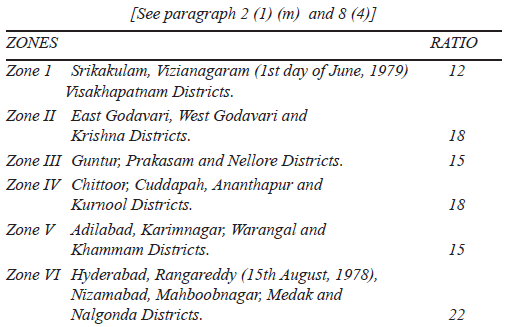
(m) (Zone) means a zone specified in the Second Schedule comprising the territories mentioned therein;
(2) The General Clauses Act, 1897 (10 of 1997) applies for the interpretation of this Order as it applies for the interpretation of a Central Act.
3. Organisation of local cadres :–
(1) The State Government shall within a period of * twenty–seven months from the commencement of this Order, organise classes of posts in the civil services of and classes of civil posts under the State into different local cadres for different parts of the State to the extent and in the manner, hereinafter provided.
(* Vide G.O. Ms. No. 728, G.A. (SPF.A) Dept, dt. 27-10-1977).
Provided that, notwithstanding the expiration of the said period, the President may by order, require the State Government, whenever he considers it expedient so to do, to organise any classes of posts in the civil services of and clauses of civil posts under the State into different local cadres or different parts of the State.
(Vide G.O. Ms. No. 34, G.A. (SPF.A) Dept, date 24-1-81)
(2) The posts belonging to the category of lower division clerk and each of the other categories equivalent to or lower then that of a lower division clerk in each department in each district shall be organised into separate cadre.
Explanation :— For the purposes of this sub-paragraph, sub-paragraph (1) of paragraph 6. and sub-paragraph (1) of paragraph 8 a category shall be deemed to be equivalent to or lower than that of a lower division clerk if the minimum of the scale of pay of a post belonging to that category or where the post carries a fixed pay, such fixed pay is equal to or lower than the minimum of the scale of pay of a lower division clerk.
(3) The posts belonging to each non gazetted category, other than those referred to in sub-paragraph (2), in each department in each zone shall be organised into a separate cadre.
(4) The posts belonging to each specified gazetted category in each department in each zone shall be organised into a separate cadre.
(5) Notwithstanding anything contained in sub-paragraph (3) and (4), the State Government may where it considers it expendient so to do and with the approval of the Central Government, organised the posts belonging to any of the categories referred to therein, in any department, or any establishment thereof, in two or more contigeous zones into a single cadre.
(6) Notwithstanding anything contained in sub Paragraphs (2), (3), (4) and (5), the Central Government ; may notify the departments in which and the categories of posts for which a separate cadre has to be organised for the City of Hyderabad and on such notification, the posts belonging to each such category in each such department in the said City (other than those concerned with the administration of areas falling outside, the said City) shall be organise into a separate cadre and the posts so organised in pursuance of this paragraph or Constituted otherwise and comprising posts belonging to the category in that department.
(7) In organising a separate cadre in respect of any category of posts in any department for any part of the State, nothing in this Order shall be deemed to prevent the State Government from organising or continuing more than one cadre in respect of such category is such department for such part of the State.
(8) Where the Central Government is satisfied that it is not practicable or expedient to organise local cadres under this paragraph in respect of any non gazetted category of posts in any department, it may, by notification, make a declaration to that effect and on such declaration the provisions of this paragraph shall not apply to such category of posts.
4. Allotment of Persons :—
(1) Persons holding posts required to be organised into local cadres shall be allotted to such cadres by the State Government or any officer or authority authorised by it in this behalf in accordance with the principles and procedure hereinafter specified.
(2) In allotting persons to local cadres due regard shall be had to all or any of the following, namely: (a) the administrative needs of the posts in the local cadres : (b) the need for the composition of balanced local cadres with reference to age and seniority groups; (c) the length of service of the persons concerned in the part of the State for which the local cadre is organised. (d) knowledge of the persons concerned of the language spoken and the law in force in the part of the State for which the local cadre is organised; (e) preference of the persons concerned for allotment to any local cadre, where feasible.
(3) The State Government may, in respect of different departments and different categories of posts, constitute committees to advice on the allotment of persons to local cadres.
(4) Any person aggrieved by an order allotting him to any local cadre may submit a representation to the State Government within a period of sixty days from the Date of communication of the order.
(5) The State Government shall on receipt of such representation and after consultation with the appropriate committee constituted under subparagraph (3) make such order as it deems fit. Provided that wherever such an order is likely to result in the change of allotment of any other person, no such order shall be made without giving an opportunity to that other person to make a representation.
(6) Every order passed by the State Government under sub-paragraph (5) shall subject to the provisions of clause (3) of article 371-D of the Constitution of India, be final.
(5) Local Cadres and Transfer of Persons :—
(1) Each part of the State, for which a local cadre has been organised in respect of any category of posts, shall be a separate unit for purposes of recruitment, appointment, discharge, seniority, promotion and transfer, and such other matters as may be specified by the State Government, in respect of that category of posts.
(2) Nothing in this order shall prevent the State Government from making provision for
(a) the transfer of a person from any local cadre to any office or Establishment to which this order does not apply, or Vice Versa.
(b) the transfer of a person from local cadre comprising posts in any office or Establishment exercising territorial jurisdiction over a part of the State to any other local cadre comprising posts in such part of Vice Versa.
(c) the transfer of a person from one local cadre to another local cadre where no qualified or suitable person is available in the latter cadre for where such transfer is otherwise considered necessary in the Public interest.
(d) the transfer of a person from one local cadre to another local cadre on a reciprocal basis subject to the condition that the persons so transferred shall be assigned seniority in the latter cadre with reference to the date of his transfer to that cadre.
(Vide G.O. Ms. No. 34, G.A. (SPF.A) Dept, dt. 24-1-1981)
6. Local Areas :—
(1) Each district shall be regarded as a local area.
(i) for direct recruitment to posts in any local cadre under the State Government comprising all or any of the posts in any department in that district belonging to the category of a lower division clerk or to any other category equivalent to or lower than that of a lower division clerk.
(ii) for direct recruitment to posts in any cadre under any local authority within under that district carrying a scale of pay, the minimum of which does not exceed the minimum of the scale of pay of a lower division clerk or a fixed pay not exceeding that amount.
(2) Each Zone shall be regarded as a local area. (1) for direct recruitment to posts in any local cadre under the State Government comprising all or any of the posts in any department in that zone belonging to any non-gazetted category other than those referred to in sub paragraph (1)
(ii) for direct recruitment to posts in any local cadre comprising all or any of the post in any department in that zone belonging to the categories of Tahsildars, Asst. Executive Engineers, Assistant Agricultural Officers, Inspectors of Police and Motor Vehicle Inspectors
(Vide G.O. Ms. No. 498, dt. 16-7-1977 G.O.Ms. No. 34, dt. 24-1-1981 and G. O. Ms. No. 635, G.A. (SPF. A) Dept. dated 30-11-1993)
(iii) For direct recruitment to posts in any cadre under any local authority within that zone, carrying a scale of pay, the minimum of which exceeds the minimum of the scale of pay of a lower division clerk but does not exceed Rs. 480/- per mensum or a fixed pay which exceeds the minimum of the scale of pay of a lower division clerk but does not exceed Rs. 480/- per mensum or any amount corresponding to it as may be specified in this regard in the successive revisions or pay scales granted by the State Government from time of time.
(G.O.Ms. 635, G.A. (SPF.A) Dept. dated 30-11-93.
Provided that where a single cadre has been organised for two or more zones under sub-paragraph (5) of paragraph 3 of posts belonging to any of the categories referred to in clause (i) or clause (ii) each of such zones shall be regarded as separate local area in respect of such cadre.
(3) Notwithstanding anything contained in sub-paragraphs (1) and (2).
(i) the City of Hyderabad shall be regarded as a local area for direct recruitment to posts in any local cadre under the State Government comprising all or any of the posts in the said City in the departments and belonging to the categories notified under Sub-paragraph (6) of paragraph 3 and the said City shall be excluded from the local area relatable to any other local cadre comprising posts in the departments and belonging to the categories so notified ; and
(ii) the City of Hyderabad shall be regarded as a local area for direct recruitment to posts in any cadre under a local authority within the said City comprising posts carrying a scale of pay the minimum of which does not exceed Rs. 480/- per mensum or any amount corresponding to it as may be specified in this regarded in the successive revisions of pay scales granted by the State Government from time to time, or a fixed pay not exceeding that amount, and the said City shall be excluded from the local area relatable to any cadre under any local authority not within the said City.
(G.O. Ms. No. 635, G. A. (SPF. A) Dept. dated 30-11-93)
(4) Notwithstanding anything contained sub-paragraphs (1), (2) and (3).
(1) the districts of Medak, Ranga Reddy and Hyderabad shall be regarded as a local area for direct recruitment to posts in any cadre under the Hyderabad Urban Development Authority comprising posts, carrying a scale of pay, the minimum of which does not exceed the minimum of the scale of pay of lower division clerk or a fixed pay not exceeding that amount.
(ii) Zone VI shall be regarded as a local area for direct recruitment to posts in any cadre under the Hyderabad Urban Development Authority comprising posts, carrying a scale of pay, the minimum of which exceeds the scale of pay of a lower division clerk but does not exceed Rs. 480/- per mensum, or a fixed pay which exceeds the minimum of the scale of the pay of a lower division clerk but does not exceed Rs. 480/- per mensum or any amount corresponding to it as may be specified in this regard in the successive revisions of pay scales granted by the State Government from time to time.
(Vide G.O.Ms. No. 498, G. A. (SPF. A) Dept. dt. 16-7-77 and G.O. Ms. No. 34, G. A. (SPF. A.) Dept, dt. 24-1-1981.)
7. Local Candidate :—
(1) A candidate for direct recruitment to any post shall be regarded as a local candidate in relation to a local area.
(a) in cases where a minimum educational qualification has been prescribed for recruitment to the posts.
(i) If he has studied in an educational institution or educational institutions in such local area for a period of not less than four consecutive academic years ending with the academic year in which he appeared or, as the case may be, first appeared for the relevant qualifying examination; or
(ii) where during the whole or any part of the four consecutive academic years ending with the academic year in which he appeared or as the case may be, first appeared for the relevant qualifying examination he has not studied in any educational institution, if he has resided in that local area for a period of not less than four years immediately preceding the date of commencement of the qualifying examination in which he appeared or as the case may be, first appeared.
(b) In cases where no minimum educational qualification has been prescribed for recruitment to the post, if he has resided in that local area for a period of not less than four years immediately preceding the date on which the post is notified for recruitment. Explanations :— For the purpose of this paragraph.
(i) educational institution means a University or any educational institution recognised by the State Government, a University or other competent authority;
(ii) relevant qualifying examination in relation to a post means;
(a) the examination, a pass in which is the minimum educational qualification prescribed for the post; (b) the Matriculation examination or an examination declared by the State Government to be equivalent to the Matriculation examination; which is lower ; and
(iii) in reckoning the consecutive academic years during which a candidate has studied, any period of interruption of his study be reason of his failure to pass any examination shall be disregarded.
(iv) the question, whether any candidate for direct recruitment to any post has resided in any local area shall be determined with reference to the places where the candidate actually resided and not with reference to the residence of his parents or other guardian
(Vide G.O.Ms. No. 168, G.A. (SPF.A) Dept. dt.10-3-77).
(2) A candidate for direct recruitment to any post who is not regarded as a local candidate under sub-paragraph
(1) in relation to any local area shall.
(a) in cases where a minimum educational qualification has been prescribed for recruitment to the post.
(i) If he has studies in educational institutions in that State for a period of not less than seven consecutive academic years ending with academic year in which he appeared or as the case may be, first appeared for the relevant qualifying examination be regarded as a local candidate in relation to (1) Such local area where he has studied for the maximum period out of the said period of seven years; or
(2) where the period of his study in two or more local areas are equal, such local areas where he has studied last in such equal periods;
(ii) If during the whole or any part of the seven consecutive academic years ending with the academic years in which he appeared or as the case may be first appeared for the relevant qualifying examination, he has not studied in the educational institutions in any local areas, but has resided in the State during the whole of the said period of seven years, be regarded as a local candidate in relation to
(1) such local area where he has resided for a maximum period out of the said period of seven years : or
(2) where the periods of his residence in two or more local areas are equal, such local area where he has resided last in such equal periods ;
(b) in cases where no minimum educational qualification has been prescribed for recruitment to the post, if he has resided in the State for period of not less than seven years immediately preceding the date on which the post is notified for recruitment, be regarded as a local candidate in relation to
(i) such local area where he has resided for the maximum period out of 20 the said period of seven years ; or
(ii) where the periods of his residence is two or more local areas are equal such local area where he has resided last in such equal periods.
(G.O.Ms. No. 168, dated 10-3-1977)
8. Reservation in the matter of Direct Recruitment:–
(1) 80% of the posts to be filled by direct recruitment any time.
(a) in any local cadre under the State Government comprising posts belonging to the category of lower division clerk or a Category equivalent to or lower than that lower division clerk; and
(b) in any cadre under a local authority comprising post carrying a scale of pay the minimum of which, or a fixed pay which does not exceed the minimum of the scale of pay or a lower division clerk, shall be reserved in favour of local candidates in relation to the local area in respect of such cadre. (
2) 70% of the posts to be filled by direct recruitment at any time.
(a) in any local cadre under the State Government comprising posts belonging to non-gazetted categories other than those referred to in item (a) of sub-paragraph (1) and
(b) in any cadre under a local authority comprising posts carrying a scale of pay, the minimum of which, or a fixed pay which exceeds the minimum of the scale of pay of a lower division clerk, but does not exceed Rs. 480/- per mensum on any amount corresponding to it as may be specified in this regard in the successive revisions of pay scales granted by the State Government from time to time shall be reserved in favour of local candidates in relation to the local area in respect of such cadre. (G.O.Ms. No. 635, G. A. (SPF. A) Dept, dated 30-11-93).
(3) 60 % of the posts to be filled by direct recruitment at any time in any local cadre under the State Government comprising posts belonging to the categories of Tahsildars, Assistant Executive Engineers, Assistant Agricultural Officers, Inspector of Police and Motor Vehicle Inspectors shall be reserved in favour of local candidates in relation to the local area in respect of such cadre.
(G.O.Ms. No. 498, G.A. (SPF. A) Dept, Dt. 16-7-1977)
(G.O.Ms. No. 34, G.A. (SPF. A) Dept, Dt. 24-1-1981)
(G.O.Ms. No. 635, G.A. (SPF. A) Dept, Dt. 30-11-1993).
(4) Notwithstanding anything contained in sub-paragraph (2) or subparagraph (3) where, in respect of any of the categories referred to in the said paragraph a single cadre has been organised for two or more zones under sub-paragraph
(5) of paragraph 3, 70% or as the case may be, 60 % of the posts to be filled by direct recruitment at anytime in such cadre shall be reserved in favour of and allocated amongst the local candidates in relation to each of the local areas in respect of such cadre in the ratio specified in the Second Schedule against the zone comprising each such local area. (5) 60% of the posts under the State Government belonging to the category of Civil Assistant Surgeons to be filled by direct recruitment at any time shall be reserved in favour of and allocated amongst the local candidates in relation to the local area specified in column
(1) the Table below in the respective ratios specified in the corresponding entry is column
(2) thereof.
(6) while determining under this paragraph the number of posts to be reserved in favor of Local candidates any fraction of a post shall be counted as one.
(7) while allocating under sub-paragraph (4) or sub-paragraph (5) the reserved posts amongst the candidates in relation to different local area fractions of a post shall be adjusted by counting successively the fractions in descending order of magnitude as one and where the fraction to be so counted cannot be selected by reason of the fractions being equal the selection shall be by lot.
(8) Notwithstanding any thing contained in the foregoing provisions of this paragraph. (a) there shall be at least one post left unreserved out of the post filled by direct recruitment at any time to any local cadre; and (b) there shall be, as far as possible, at least one post allocated for the local candidates in respect of each local area.
(9) Carry forward of reserved posts:—
If a qualified local candidate in respect of a local area is not available to fill a post reserved or allocated in favour of a local candidate in respect of that local area, such post shall be carried forward for recruitment of a local candidate in respect of that local area for period not exceeding three years:— Provided that pending recruitment of a local candidate.- Such post may be filled in temporarily by borrowing the service of a person holding a post of the same category in any other local cadre or under any other local authority as the case may be
(Vide G.O. Ms. No. 34, dt. 24-1-1981).
10. Power to Authorise issue of Directions : —
(1) The President, may, by order, require the State Government to issue such directions as may be necessary or expedient for the purpose of giving effect to this Order to any local authority and such local authority shall comply with such directions.
2) The State Government may, for the purpose of issuing any direction under sub-paragraph (1) or for satisfying itself that any directions issued under sub-paragraph (1) have been complied with require by order in writing any local authority to furnish them such information, report of particulars as may be specified in the order and such local authority shall comply with such order.
11. Order to have over - riding effect : —
The provision of this order shall have effect notwithstanding anything contained in any Statute, Ordinance, rule, regulation or other order made before or after the of this order in respect of direct recruitment to posts under the State Government or any local authority.
12. Removal of Doubts: — For the removal of doubts, it is declared that nothing in this Order shall affect the operation of provisions made by the State Government or other competent authority before or after the commencement of this Order in respect of reservation in the matter of appointments to posts in favour of any backward classes of citizens, the Schedule Castes and Schedule Tribes in so far such provisions are not inconsistent with this order,
13. Certain appointment and promotions to be Provisional:— appointment or promotion made after the commencement of this Order or order made in pursuance of the provision to paragraph 3, as the case be and before any local cadre has been organised under the provisions this order or any order made in pursuance of the provision to paragraph 3, to any post which is required to be included in such cadre shall provisional and shall, within a period of twelve months after such organisation, be reviewed and readjusted in accordance with the provisions of this order, Explanation :— For the purposes of this paragraph, any local cadre shall be deemed to be organised with the allotment of persons to it under paragraph 4.
(Vide G.O. Ms. No. 34, G.A (SPF. A) Dept., dt. 24-1-81)
14. Saving:— Nothing in this Order shall apply to :—
(a) any post in the Secretariat of the State Government.,
(b) any post in an office of the Head of a Dept.,
(c) any post in a special office or Establishment :
(d) any post in a State-level office or institution.
(e) any post other than a post belonging to any of the non-gazetted categories in the ministerial and technical services in a Major Development project;
(G.O. Ms. No. 455, G.A. (SPF.A) Dept., dt.3-10- 1985 and
(f) any post Police Officer as defined in clause (b) of Section 3 of the Hyderabad City Police Act, 1348 F.
THE FIRST SCHEDULE
THE SECOND SCHEDULE
THE THIRD SCHEDULE